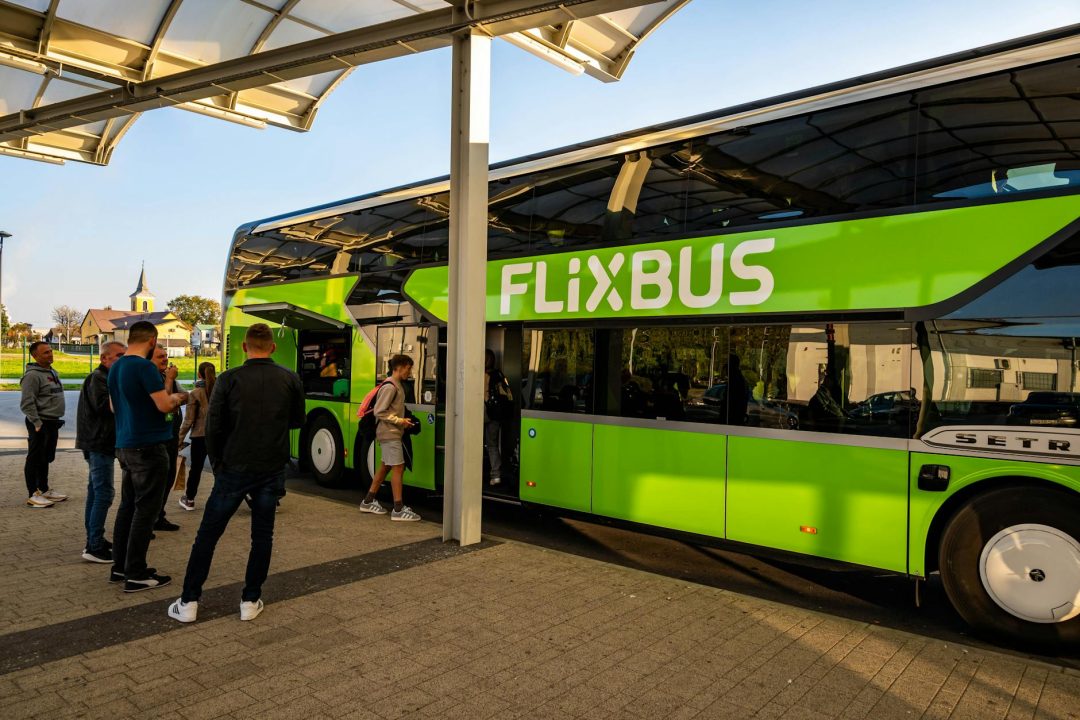
If you’ve been following along for a while now, you’ll know that I love to travel around by public transport. Not only is it cost-effective, but you often get to see and experience a lot more of a place when you’re not stuck behind a steering wheel.
While most cities and countries have their own systems, there are a few companies that transcend borders. One of these companies is FlixBus. You’ve probably seen their big green buses around, whizzing down motorways or picking up at airports and bus stations in major cities.
The destinations they cover are far-reaching, with further expansions expected down the line. So far, you can find FlixBus routes across:
- Europe
- The US
- Canada
- Mexico
- Chile
- Brazil
- India
Primarily, I’ve experienced FlixBus in Europe. However, it seems like they’ve taken over Greyhound in the US and Canada, amalgamating a lot of the routes. I’ve also written about my cross-border Greyhound experience on a trip around the Pacific Northwest here.
So, without further ado, let’s get into my honest review of FlixBus.

Destination Options
First things first, one of the best things about FlixBus is that they go to a ridiculous number of destinations. There are the standard cities and large towns, but they also go to ferry ports, airports, and national park spots. For example, you can currently get a FlixBus in the UK to Aviemore in the stunning Cairngorms.
If you have an early morning flight in Europe (the budget airlines love to do it), often the trains aren’t running yet. However, the FlixBus routes run throughout the night, so sometimes they line up to help you get to the airport without spending a fortune on taxis.
You can also book a FlixBus that includes a ferry crossing in the price of the ticket. You can currently do this from mainland England to Ireland, through the Welsh town of Holyhead to the Dublin ferry. Getting to and from ferry ports can be tricky, so having a through-ticket from city to city helps take the stress out of things.
With a presence on four continents, FlixBus is definitely growing. However, in South America and Asia, the routes are restricted to being within the specific country (Chile, Brazil, and India, respectively). While this is great for exploring one specific country, it doesn’t help if you want to do a border crossing or explore the wider continent. Of course, you can still do this on FlixBus in Europe and North America, as there are cross-border routes running consistently.
Prices

One of the best things about FlixBuses is how cheap they are. You can get fares for as low as £4.49. For our ride from Stockholm to Stockholm Airport, it cost £15.49 each, and that was an early morning bus. If we had taken the Arlanda Express train, it would’ve cost £27 each.
The price also includes one piece of luggage per person in the hold and one small bag or cabin bag onboard. This is ideal for places where luggage racks on trains get full quickly, or if you’re thinking of flying short-haul but will have to pay extra for baggage.
For long-haul options, there are plenty of routes that run through the night. While they’re not like the sleeper buses in Asia with cabins or the sleeper train with small bunks, they can save you money on accommodation while you continue to travel. For example, if you took the FlixBus from Berlin to Tallinn in Estonia, you’d be traveling for almost 23 hours straight, and the ticket costs £109.99. You can’t get a direct train between these two European capitals, and you’ll end up paying a lot more and accommodation along the way when the connections don’t add up!
Timings
Unlike metropolitan public transport, FlixBuses don’t run at regular intervals. It’s kind of the luck of the draw when it comes to timings. Sometimes they’ll match up with your plans, and sometimes they won’t. If it’s a short or frequent route, then usually there are more options.
In my experience, FlixBuses don’t always leave on time. When we were waiting at the Stockholm bus station for our airport ride, it was around 20 minutes late, and some of the passengers were getting concerned about catching their flight. As it’s road-based transport, traffic happens, so you need to allow more time for any connections, check-ins, or events.
However, I’ve caught FlixBus in France, and it was bang on time leaving Nice for Marseille. It does vary from place to place and even from one bus to another. It’s largely fine if you’re being picked up from a bus station, city stop, or airport; however, if you’re at a more rural stop, it can feel sketchy sometimes, like you’ve already somehow missed it.
Onboard Experience

Once you’re onboard, FlixBuses are largely pretty decent. You get free WiFi (nothing amazing speed-wise, but good enough), plug sockets to charge your phone, and air-con. It ticks all the boxes for a coach, whether it’s long haul or short haul. Some buses won’t have all of these options, because FlixBus sometimes subcontracts the buses from local companies, and they’re not as decked out. When you book your ticket, there are icons for power outlets, WiFi, and air-con underneath the destination.
There is usually one toilet onboard, but for longer journeys, the driver will often have a stop for a longer rest break at services or a cafe. Sometimes they just swap drivers, so pay attention to when the bus is leaving again!
In terms of the seats, I find them pretty comfortable, but at 5ft1, I don’t have much need for a ton of legroom. I will say you get way more legroom and space than on a Ryanair flight, and the seats are nicely padded, so you can get some sleep.
There are also reading lights and curtains if you’re traveling at night. This is great for getting a nap in without getting blinded by motorway headlights coming the other way.
Booking and the App
I’ve booked once through the website, but I usually use the FlixBus app. It’s really easy to use and book through, and then you have the tickets in the app ready to show the driver. You can also access the interactive route map through the app, but more about that in a minute.
One of the underrated features of the app is the timetable tab. You can select your bus station or city and see every bus that’s going out for the next couple of days, complete with timings. If you’re feeling spontaneous about a day out or a weekend away, you can see the full schedule without manually using trial and error with destinations.
You can switch the currency up if you’re in a new place or if you want to swap back to your home currency to figure out how much you’re actually spending. The same goes for the language.
However, when I booked my tickets in Stockholm, I was obviously using the Swedish location settings and consequently got all my FlixBus marketing emails in Swedish.
Route Planning

FlixBus has my favorite route planning tool of any public transport, and that is the route map. You click in, and it shows you everywhere that FlixBus goes. Once you click or type in your starting point, the dots will start disappearing, showing only the ones you can get to from that starting point. It’ll also show you the price for some of them, and others you’ll need to click into.
However, my one gripe with this route planner is that there’s no filter for direct routes. For example, from Liverpool, it says I can get to Aberdeen for £68 one-way. When I click in, that’s if I go via London, which adds another 10 hours of travel in the wrong direction and doubling back on myself.
This would be fine, but when the dots disappear when you click on your home location, some destinations disappear that are still within one or two changes, if you were doing this level of ridiculous double-backing.
However, by and large, I love the route map. If I don’t know where I want to go, I’ll have this route map open with Skyscanner everywhere search in another tab. Then, I can pick a cheap flight, and even if I don’t particularly want to visit that destination, I can see what FlixBuses are heading out from that city or even the airport directly.
Overall Verdict on FlixBus
Generally, I like FlixBus. The prices are reasonable and the app is really easy to use. I like how they operate out of a lot of airports, which gives another faff-free option of getting into the city after a flight. Compared to some countries’ expensive train networks or hiring a car to drive along terrifying roads, it’s a great option that I always check when I’m traveling.
However, it’s not without its reservations. The roundabout routes it sometimes takes you on aren’t great if you’re short on time. Also, sometimes the route map will suggest an option that’s completely outrageous because its connections don’t line up. In these instances, I’d use Rome2Rio or Omio to see if you can get a different bus or train to the connection that works best. FlixBus routes are on Omio as well, so you can combine them with other tickets really easily.
For UK travel specifically, it’s nice to have another budget-friendly bus operator to choose from. MegaBus is dwindling its routes, and National Express has a bit of a monopoly. I’m a big National Express fan, and at the moment, they unsurprisingly have more routes and more frequent options than FlixBus in the UK, but that could be set to change if FlixBus takes off in the UK.

This is a timely post for me as I was thinking of using this service soon. While I prefer trains, there are several countries I want to visit where taking a bus is the only option,
Thanks for including helpful details on power sockets, toilets etc as these are crucial for long distance travel.
Thanks again for this.
No problem at all Elizabeth! It’s becoming a more flexible option, especially for emerging destination with fewer rail links, but people don’t know about it yet!
Having spent a few weeks in Europe recently and we found Flixbus very convenient.
However, we did consider them the ‘Ryanair of the road’ as the drivers were mostly on a time restraint and if there was any anomaly with the ticket (qr scanner not working properly etc) they just wouldn’t let you on the bus. Had to argue a few times to get them to rescan as they were obviously having problems with other people’s tickets also. Their main refrain seemed to be “not my problem”.
Also, sometimes the Flixbus stops were a bit ‘around the corner’ from the normal bus stations or stops and weren’t clearly marked. Anyhow – they mostly worked out ok.
I recently traveled to Niagara Falls. Firstly, it seems that the FlixBus Rapidsview stop in Niagara Falls is a figurative version of Siberia, where it is basically miles from the strip and in the middle of no where. Apparently, if you get to Table Rock, a few miles out, it offers a free shuttle from there, and only there, to Rapidsview. But, it is rather inconvenient even on a good day. People should further note, though, that once at Rapidsview, there is zero signage at the We Go stop/canopy and the FlixBus stop is a few hundred meters away from there.
People should also note that there is only a public restroom at this stop and no welcome center or place to stay out of the cold while you await your bus time. So try not to get there too early, as my unfortunate circumstances led me to. The date was Friday Jan 30 and there was an extremely cold breeze coming from the falls, making the air feel like minus 20 Celsius that day. And this is where my FlixBus story really takes a turn for the far worse.
You see something came up and I needed to leave earlier for Toronto. I did not have only access to make the ticket change, so I would arrive there at 11 AM and explain to an earlier FlixBus driver my situation in needing to get back to Toronto urgently, after proving my ticket is authentic for a later time spot of course, and merely ask that driver to allow me to return early on one of the clearly available seats.
As it was. I arrived at 10:55 but was unaware of where the FlixBus stop was and Missed the 11 AM to Union Station by 2 minutes. So I did manage to wait for the 1 PM FlixBus arrival at Rapidsview, albeit in the bitterly cold temps. The 1 PM was there early, but parked about 100 meters away for the stop waiting for 1 PM to arrive to spin around to the stop for picking up the passengers. So I approached the driver of this bus and asked politely if I could board the 1 PM bus using my later 2:45 PM ticket. I was under no understanding she would later refuse me from boarding.
1 PM rolls around and I boarded the bus, so I presented the driver my 2:45 ticket, allowing her to see it was a valid ticket. She scanned it, and perhaps unsurprisingly, the ticket failed because it is for the later 2:45 PM slot and not this slot. But, and I say this respectfully, under the circumstances this driver should have spared me from the cold and allowed me to return to Toronto early since I did at least offer an official ticket for the 2:45 slot. She said go change it on the website, I said I can’t as I had no online access to do so. The driver then said, “not my problem” in the most caustic, sarcastic and uncivilized way. Completely unsympathetic to my situation, even after pleading with her to allow me to return home early so as to not be forced to stay outside in the -20 temps for almost another 2 hours until my official 2:45 time slot.
And just like that, this driver showed me that they lack even the most basic of customer service skills. Contacted their customer service, but it is like ordering a burger at a fast food joint. They give you the, “very sorry to hear”, “we will make sure this never happens again”, but after the third attempt all with similar FlixBus representative pitches, it became very clear that the matter was never elevated to management.
How hard would it have been for a FlixBus driver to allow me to use an earlier slot with many seats clearly available on the bus, for at least sparing me from waiting another two hours in the bitterly cold temps at a stop that did not even have a basic glass structure in place? Not that difficult, is my position, if the driver was truly caring and sympathetic of my situation. Done with FlixBus. Done like dinner and I do not plan on using them again. I vote with my money, and this vote is a resounding no for further supporting such an organization.
Shame on you driver of the 1 PM Friday Jan 30 Rapidsview stop.
Wow that’s so harsh from all the drivers, especially given the temperatures! Admittedly, if you’re not travelling on FlixBus from a bus station, some of their stops can be really hard to find and the signage definitely needs work.
I am hopefully starting work as a driver in the next week or so and have taken this incident onboard so I will do my very best to make this my undivided attention and if there is a spare seat make our office know and make the customer comfortable. no need to be nasty, I am sure there is a way.
Please don’t report me as I need this job.